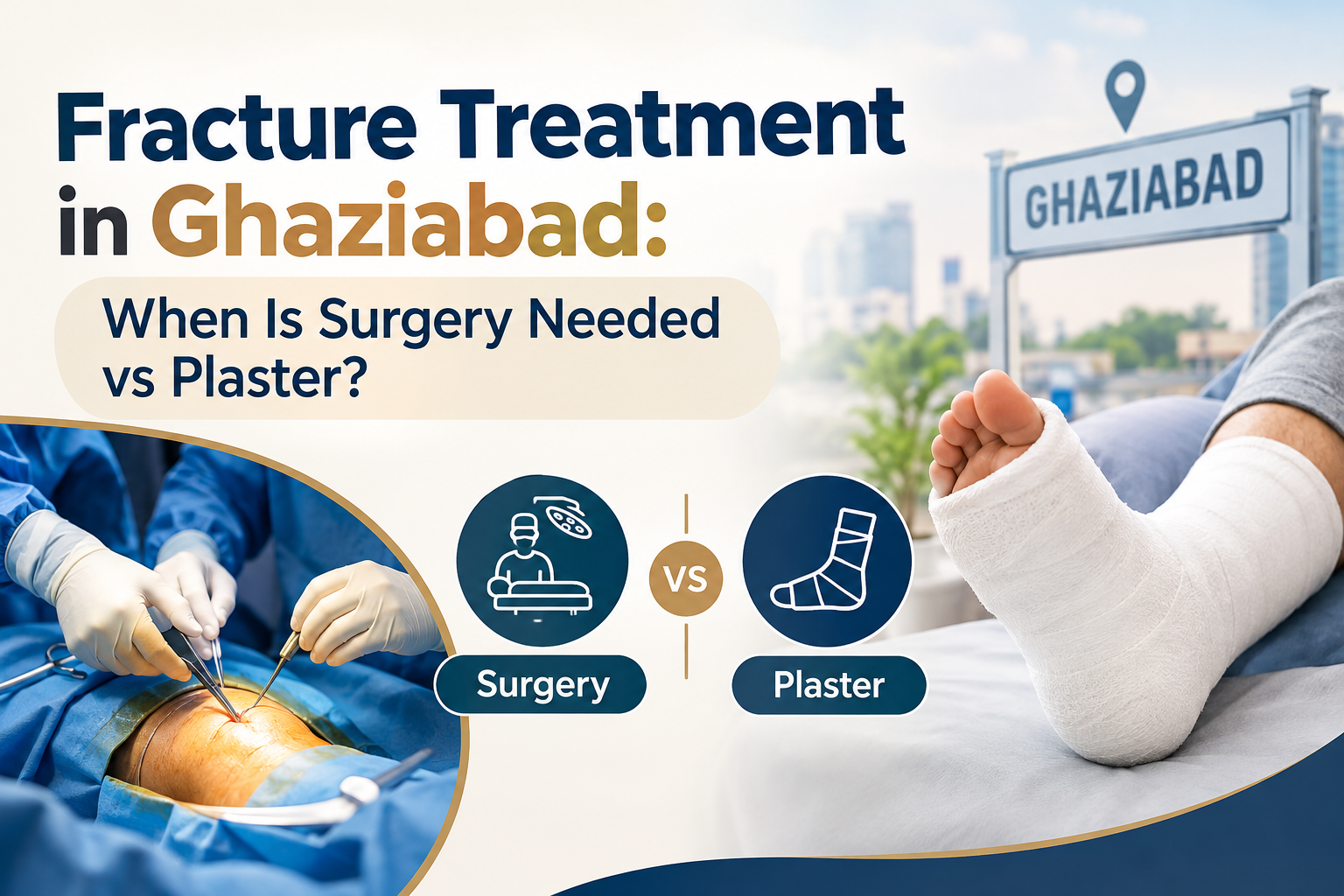
A fall, a road accident or a sports injury can leave you with one urgent question: will this fracture heal in a plaster, or do I need surgery? The honest answer is that it depends on the bone, the type of break and your overall health, and only an examination with an X-ray can settle it. This guide explains, in plain language, how orthopaedic surgeons decide between plaster and surgery for fracture treatment in Ghaziabad, which warning signs need emergency care, and what recovery looks like.
It is written for patients and families by Dr. Deepankar Verma, a consultant orthopaedic surgeon who treats complex trauma and fractures and consults at Vasundhara in Ghaziabad, Kashmere Gate in Delhi and Sector 71 in Noida.
Key takeaways
- Stable, non-displaced fractures often heal well in a plaster cast, splint or brace.
- Surgery is usually needed for open, displaced, unstable, multi-fragment or joint-involving fractures, and for most hip fractures.
- A hip fracture in an older adult is best operated on as soon as the patient is medically fit, ideally within 24 to 48 hours.
- Never massage, "set" or tightly bandage a fresh fracture. Get an X-ray from a qualified orthopaedic doctor first.
- Many fractures take about 6 to 12 weeks to unite. Recovery is smoother when you attend follow-ups, eat well and avoid tobacco.
What Happens When a Bone Breaks?
A fracture is simply a break in a bone. It can be a thin crack (a hairline or stress fracture) or a complete break in which the bone splits into two or more pieces. Doctors describe fractures in a few ways, and these descriptions drive the treatment decision:
- Closed or open: In a closed fracture the skin is intact. In an open (compound) fracture the bone has come through the skin, or a wound leads down to the fracture, which carries a high risk of infection.
- Displaced or non-displaced: In a non-displaced fracture the broken ends stay in line. In a displaced fracture they have shifted out of position.
- Stable or unstable: A stable fracture is unlikely to move once aligned. An unstable one tends to slip even inside a cast.
- Simple or comminuted: A comminuted fracture is broken into several fragments.
- Joint involvement: A break that runs into a joint surface (intra-articular) must be aligned very precisely to protect the joint from early arthritis.
Fractures can also happen from minor falls when bones are weak, as in osteoporosis, and in children, whose growing bones have special areas called growth plates that need careful assessment.
When Is Plaster or Non-Surgical Treatment Enough?
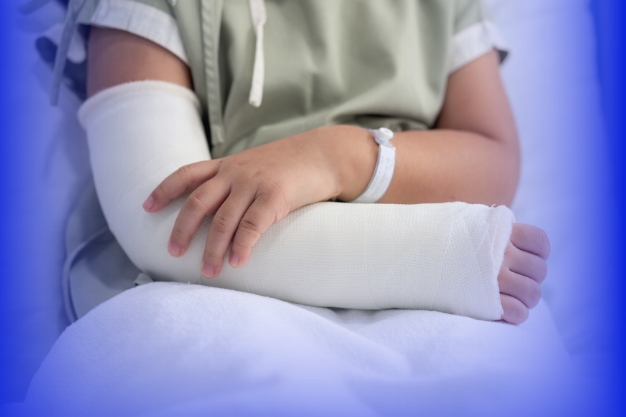
Non-surgical treatment means the bone is held in a good position while it heals naturally, using a plaster cast, splint, brace, sling or traction. It is usually a good option when:
- the fracture is non-displaced or only slightly displaced and the alignment is acceptable;
- the fracture is stable and unlikely to shift;
- the skin is intact and the nerves and blood supply are normal;
- the bone and location are known to heal reliably without surgery, for example many collarbone, wrist, rib, finger, toe and some ankle fractures; or
- the patient is a child whose fracture can straighten (remodel) as the bone grows.
Plaster is not a lesser option. For the right fracture it is the best treatment because it avoids the risks of an operation. The key is that it is chosen after proper imaging and checked with follow-up X-rays, because a fracture that slips inside a cast may later need surgery.
When Does a Fracture Need Surgery?
Your surgeon is likely to recommend an operation when:
- The fracture is open. Urgent cleaning of the wound, fixation of the bone and antibiotics are needed to prevent infection.
- The bone is displaced or unstable and cannot be held in position with a cast.
- The fracture is comminuted, with several fragments.
- The break enters a joint surface and the pieces must be aligned accurately.
- Nerves or blood vessels are injured, or the limb shows signs of compartment syndrome (see the warning signs below).
- A large weight-bearing bone is broken, such as the thigh bone (femur), the shin bone (tibia) or the pelvis and hip socket.
- It is a hip fracture in an older adult, where surgery allows early sitting, standing and walking and lowers the risks of prolonged bed rest.
- The fracture has slipped in plaster, has not healed (non-union) or has healed in a wrong position (malunion).
- There are multiple fractures after an accident, or a fracture in a diseased bone, where stabilising the bones makes movement and nursing care possible.
Surgery is not chosen because a fracture simply looks bad on an X-ray. It is chosen when it is likely to give better alignment, earlier movement and a lower chance of long-term problems than a cast would.
Plaster vs Surgery at a Glance
| Factor | Plaster / non-surgical | Surgery |
|---|---|---|
| Bone position | Not displaced or only slightly displaced | Displaced or cannot be held in position |
| Stability | Stable, unlikely to slip | Unstable or in multiple fragments |
| Skin and wound | Skin intact (closed fracture) | Open fracture or badly damaged soft tissue |
| Joint surface | Joint surface not involved | Fracture enters the joint |
| Nerves and vessels | Normal | Injured or at risk |
| Typical examples | Many collarbone, wrist, rib, finger, toe and some ankle fractures; many children's fractures | Hip fractures, thigh and shin bone fractures, open fractures, most complex joint fractures |
| Main goal | Hold the bone in good position while it heals | Restore alignment, stabilise the bone and allow earlier movement |
Common Fracture Surgeries Explained
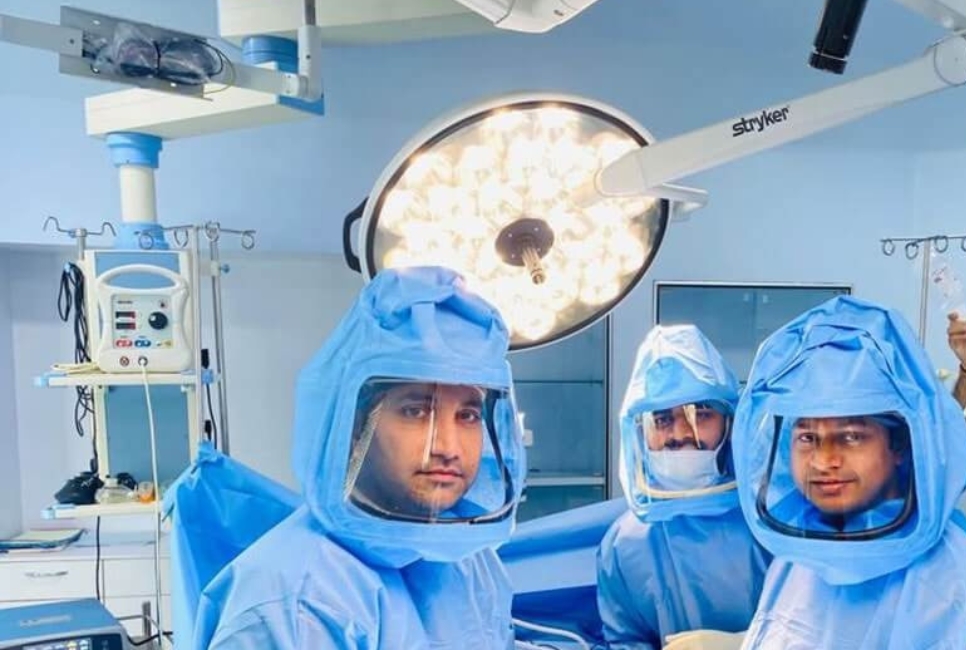
- Plate and screws (ORIF): After the fragments are realigned through an incision (open reduction), a metal plate and screws hold them together (internal fixation). It is often used for forearm, wrist, joint and ankle fractures.
- Intramedullary nail (rod): A metal rod is passed inside the hollow centre of a long bone such as the thigh bone or shin bone. In many cases it allows earlier weight-bearing.
- Screws, pins and wires: Smaller fixation is used for small bones, fingers, toes and some children's fractures.
- External fixator: A frame outside the body is attached to the bone with pins. It is used for open fractures, badly damaged soft tissue or as temporary stabilisation before final surgery.
- Hip fracture surgery: Depending on the fracture pattern, your age and activity level, the surgeon may fix the fracture with screws, a plate or a nail, or replace the broken part of the joint with a partial or total hip replacement.
Which method is used is a decision for your surgeon after imaging, taking into account the bone, the fracture pattern, the condition of the skin, and your age and health. In many patients the implant can stay in the body without problems. Removal, if ever needed, is decided case by case.
Hip Fracture in the Elderly: Why Waiting Is Risky
A hip fracture in an older person is a medical emergency in practice, even when it does not look dramatic. Typical signs are severe pain in the hip or groin after a fall, being unable to stand or bear weight, and a leg that looks shorter or turned outward.
Treating a hip fracture without surgery usually means weeks in bed, which raises the risk of chest infection, blood clots, pressure sores, confusion and loss of independence. For this reason, guidelines generally advise surgery as soon as the patient is medically fit, ideally within 24 to 48 hours, after the physician and anaesthetist have checked the heart, blood sugar, blood pressure and other conditions. Many patients are then encouraged to sit up and stand with support within a day or two, guided by the surgeon and physiotherapist. You can read more about the different types of hip replacement surgery if a partial or total replacement is advised.
If an older family member has had a fall and cannot walk, do not wait to see whether the pain settles. Get an X-ray the same day.
Warning Signs: Go to the Emergency Room Immediately
- Bone is visible, or there is a bleeding wound near the injury (open fracture).
- The limb looks bent, twisted or clearly out of shape.
- The hand or foot below the injury is pale, blue, cold or numb.
- Severe pain keeps increasing or is not relieved by rest, with a tense, swollen limb (possible compartment syndrome).
- The injury involves the head, neck, back or pelvis, or followed a major road accident or a fall from height.
- You cannot put any weight on the leg or move the arm at all.
- There is heavy bleeding, dizziness or fainting.
These situations need immediate hospital care and cannot wait for an OPD appointment. Call 112 or go to the nearest hospital emergency department.
What to Do Right After a Fracture (First Aid)
- Keep the person still and calm. Do not move the injured part unnecessarily.
- Stop any bleeding by pressing a clean cloth over the wound. Do not push exposed bone back in.
- Support the limb in the position you found it with a splint, such as a firm board or rolled newspaper padded with cloth, tied loosely above and below the break. Do not try to straighten it.
- Apply a cold pack wrapped in cloth for short periods. Never put ice directly on the skin.
- Raise the limb gently if this does not increase the pain.
- Avoid eating or drinking until a doctor has examined you, as surgery under anaesthesia may be needed.
- Go to a hospital for an X-ray. If a neck, back or pelvis injury is possible, do not move the person and call for an ambulance.
How Your Orthopaedic Surgeon Decides
Examination and imaging. The doctor checks the injured area, the skin, the pulses, sensation and movement of the fingers or toes. An X-ray, usually from two angles, confirms the fracture and shows displacement and stability. A CT scan may be advised for complex fractures near joints or in the pelvis and spine. An MRI helps when a ligament injury, hidden fracture or stress fracture is suspected.
Beyond the X-ray. The decision also considers your age and bone quality, general health (for example diabetes, heart or kidney conditions), the medicines you take, your occupation and activity level, and the condition of the skin and soft tissue. A good surgeon explains both options, including the risks of each, and involves you in the decision.
Fracture Healing and Recovery: What to Expect
A fracture heals at its own pace whether it is treated in a cast or with surgery. Surgery holds the bone in place. It does not make the bone heal faster.
- Timeline: Many fractures take about 6 to 12 weeks to unite. Thigh and shin bones can take longer, and children usually heal faster.
- With a cast: The cast stays on for several weeks, with follow-up X-rays to confirm the bone has not slipped.
- After surgery: Wound care, early movement and physiotherapy are guided by your surgeon, and weight-bearing is increased in stages.
- What slows healing: Smoking or tobacco, uncontrolled diabetes, poor nutrition, low vitamin D, infection and not following instructions.
- What helps: A protein-rich diet, calcium and vitamin D as advised by your doctor, regular follow-ups and completing your physiotherapy.
If your treatment involves a hip replacement, these tips for recovery after hip replacement surgery can help you plan your rehabilitation.
Common Mistakes That Delay Fracture Healing
- Getting the limb massaged or "set" by an untrained person, which can displace the bone and injure nerves or blood vessels.
- Using tight traditional bandages or herbal pastes instead of getting an X-ray.
- Waiting several days for the swelling to settle before seeing a doctor.
- Removing the cast early because it itches or the pain has eased.
- Putting weight on the limb before the surgeon allows it.
- Smoking, and skipping follow-up visits or physiotherapy.
A delay of even a few days can turn a straightforward fracture into one that needs a bigger operation, or leave a bone that heals crooked. Seeing an orthopaedic doctor in Ghaziabad early gives you the most treatment options.
Fracture Treatment in Ghaziabad: Where to Consult Dr. Deepankar Verma
If you are looking for fracture treatment in Ghaziabad, you can consult Dr. Deepankar Verma at Varenya Healthcare Centre in Vasundhara. The clinic is an option for patients in Vasundhara, Indirapuram, Vaishali, Kaushambi, Raj Nagar, Raj Nagar Extension, Crossings Republik, Vijay Nagar, Sahibabad, Shalimar Garden, Mohan Nagar, Kavi Nagar, Loni and nearby areas of Ghaziabad. He also consults in Kashmere Gate, Delhi and in Sector 71, Noida.
| Location | Address | OPD days and timings |
|---|---|---|
| Varenya Healthcare Centre, Vasundhara, Ghaziabad | 1139/1, MIG Houses, Sector 3, Vasundhara, Ghaziabad, Uttar Pradesh 201012 | Monday to Saturday, 6:30 PM to 8:30 PM |
| Sant Parmanand Hospital, Kashmere Gate, Delhi | 2 & 3, Park Area, Yamuna Bazar, Plot No 1, Ring Road, Kashmere Gate, New Delhi 110006 | Monday 11 AM to 1 PM, Tuesday 12 PM to 2 PM, Thursday 12 PM to 2 PM, Friday 11 AM to 1 PM |
| Kailash Hospital and Neuro Institute, Sector 71, Noida | NH-1, B Block, Sector 71, Noida, Uttar Pradesh 201316 | Wednesday and Saturday, 9 AM to 11 AM |
OPD timings can change, so please check the OPD schedule or call +91-7065807070 before you visit. In an emergency, do not wait for the OPD. Go to the nearest hospital emergency department.
Why Patients Trust Dr. Deepankar Verma for Fracture and Trauma Care
- Qualifications: MBBS, MS, FASM, FJR, with a fellowship in joint replacement and sports medicine.
- Experience: Over 9 years of clinical practice in orthopaedic surgery, including complex trauma, hip and knee replacement, and foot and ankle surgery.
- Hospital roles: Consultant at Sant Parmanand Hospital and Kailash Hospital and Neuro Institute, and runs Varenya Healthcare Centre.
- Recognition: Recipient of the Bhagwan Prasad Gold Medal Award for best paper publication, with publications in national and international orthopaedic journals. See the accreditation and awards page.
- Professional memberships: Life member of the Indian Orthopaedic Association, Delhi Orthopaedic Association, UP Orthopaedic Association, UP Arthroscopy Association, Indian Arthroscopy Association and Indian Foot and Ankle Society.
You can also read a family's account of leg fracture treatment or browse more patient testimonials. Individual results vary from patient to patient.
Frequently Asked Questions
Do all fractures need surgery?
No. Many fractures that are stable and not displaced heal well with a plaster cast, splint, brace or sling. Surgery is usually needed when the bone is displaced or unstable, the fracture is open, a joint surface is involved, or a fracture does not hold its position or heal in a cast. An orthopaedic surgeon decides after an examination and an X-ray or scan.
How do I know if my fracture needs surgery or plaster?
You cannot judge this from pain or swelling alone. The decision depends on the X-ray, which shows how far the bone has shifted, whether the fracture is stable and whether a joint is involved, along with the condition of the skin, nerves and blood supply, your age, your general health and the activity you need to return to. Get the injury examined and X-rayed by an orthopaedic doctor as early as possible.
How long does a fracture take to heal?
Many fractures take about 6 to 12 weeks to unite, while large bones such as the thigh bone and shin bone can take longer. Children usually heal faster. Smoking, uncontrolled diabetes, poor nutrition and infection can slow healing. Surgery holds the bone in position, but the bone still needs time to heal.
Is fracture surgery safe?
Fracture surgery is a well-established procedure, but like any operation it carries risks such as infection, bleeding, anaesthesia-related risks and delayed healing. Your surgeon will check your fitness for surgery, explain the benefits and risks for your specific fracture, and discuss alternatives before you decide.
Can I walk after fracture surgery?
It depends on the bone, the fracture pattern and how it was fixed. After hip fracture surgery, many patients are encouraged to stand and walk with support within a day or two. After some leg fractures, weight-bearing has to be limited for several weeks. Follow the instructions of your surgeon and physiotherapist.
What should I do immediately after a fracture?
Keep the injured part still, support it with a splint in the position you found it, press a clean cloth on any bleeding wound, apply a cold pack wrapped in cloth, do not try to straighten the bone, avoid eating or drinking until a doctor has examined you, and go to the nearest hospital for an X-ray. Call 112 for severe injuries. See our first aid steps above.
Which doctor should I see for a fracture in Ghaziabad?
You should see an orthopaedic surgeon, ideally one with experience in trauma care. Dr. Deepankar Verma consults at Varenya Healthcare Centre in Vasundhara, Ghaziabad on weekday and Saturday evenings, at Sant Parmanand Hospital in Kashmere Gate, Delhi, and at Kailash Hospital in Sector 71, Noida. Please check the OPD schedule page for current timings or call +91-7065807070.
Not sure whether your fracture needs plaster or surgery?
Do not guess. Book a consultation with Dr. Deepankar Verma for an examination and a clear treatment plan. Choose Vasundhara, Kashmere Gate or Noida.